Curved and helical steel stairs
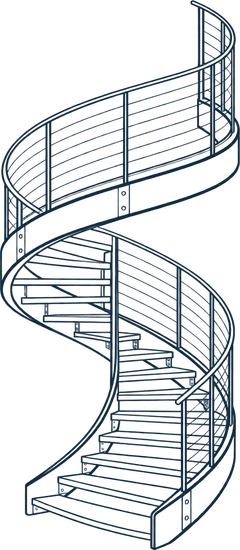
Curved stairs are the work we are known for. We roll the stringers from plate, fold the treads, and trial assemble the whole stair in our Wetherill Park workshop so every joint is right before it goes to site. Then our own crew installs it, as we did for the MinterEllison helical stair in Canberra.

How we do it
Rolled to the drawing
Stringers are rolled from plate to the radius on the architect and engineer drawings before the treads are welded in.
Trial assembled in the workshop
The stair is built up complete under our gantry cranes. Problems are found on our floor, not on yours, and the stair arrives ready to lift in.
Installed by the people who built it
The same team that fabricated the stair installs it, including staged lifts into fitted out floors and tight voids.
Finished the way the design asks
Plastered soffits, timber or stone treads, glass or steel balustrades: we coordinate with the trades that finish the stair so the steel suits them.
What we work with
- Rolled steel plate stringers
- Folded plate treads ready for timber, stone or carpet
- Steel, stainless or glass balustrades
- Primed, painted or powder coated
Curved stairs we have built


Questions
Read more in our guide: How a curved steel stair is made, from flat plate to installed
Can you build a curved stair from our architect's drawings?
Yes. Most curved stairs start with the architect's design and an engineer's details. We turn those into fabrication drawings and send them back for approval before we cut any steel.
How is a curved stair installed in a finished building?
It is planned around the site. Depending on access we deliver the stair whole or in sections, lift it in with cranes or chain blocks, and join it on site. We work this out with the builder before fabrication starts.
What is the difference between a curved stair and a spiral stair?
A spiral stair winds around a centre column. A curved or helical stair has no centre column: the stringers themselves carry the stair around the curve, which leaves an open well in the middle.
Get a quote for curved stairs
Attach plans, sketches or photos and tell us where the job is. We will look over it and come back to you with a quote.
Workshop: Unit 1, 11-13 Potter Close,
Wetherill Park NSW 2164
Thanks, we have your enquiry
We will look over the details and get back to you soon.